
The Question
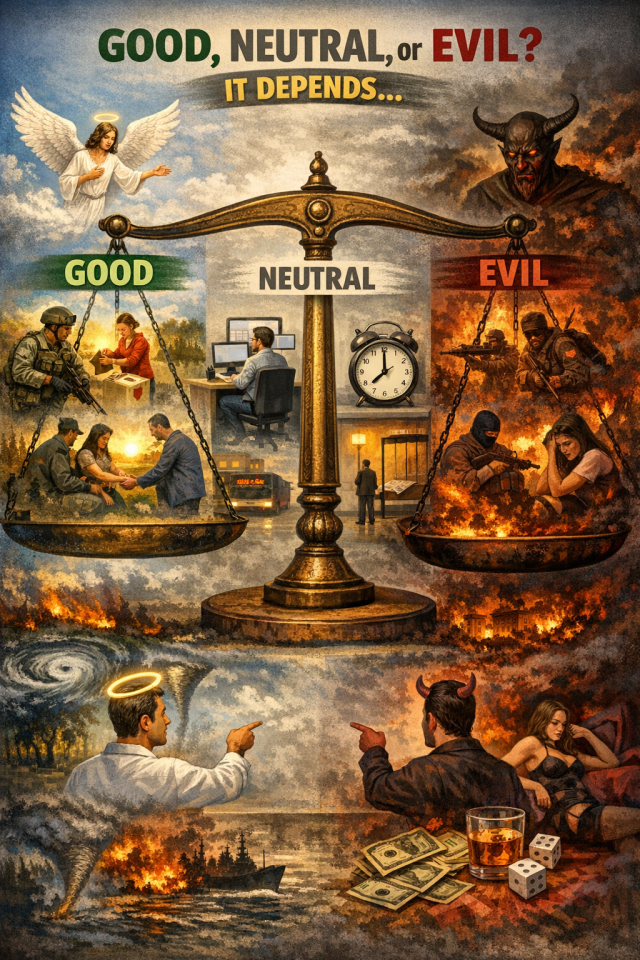
Is every thought, word, and action judged to be either good or evil? Or is there neutral ground? The short answer is: it depends. It depends on what standard of measurement is used to determine good, evil, or neutral.
We, humans, have a tendency to judge major events, thoughts, and actions as good or evil. Natural disasters, such as hurricanes, ice storms, wildfires, tornadoes, etc., would rank as natural evils, while wars, poverty, oppression, murder, rapes, etc., would be ranked as moral evils.
The more mundane ins and outs of life where we just exist—the getting up, going to work, coming home, and going to bed routine—would be considered neither good nor evil. Most would consider the mundane as neutral. But is this really the case?
We, humans, are also guilty of changing the standard to fit our purposes. We generally are easier on ourselves than we are on others. We tend to judge our motives positively and others negatively, or ours as good intentions and others with less than good intentions. So, when we measure ourselves against others, we seem to be pretty good or at least not that bad.
No Neutral
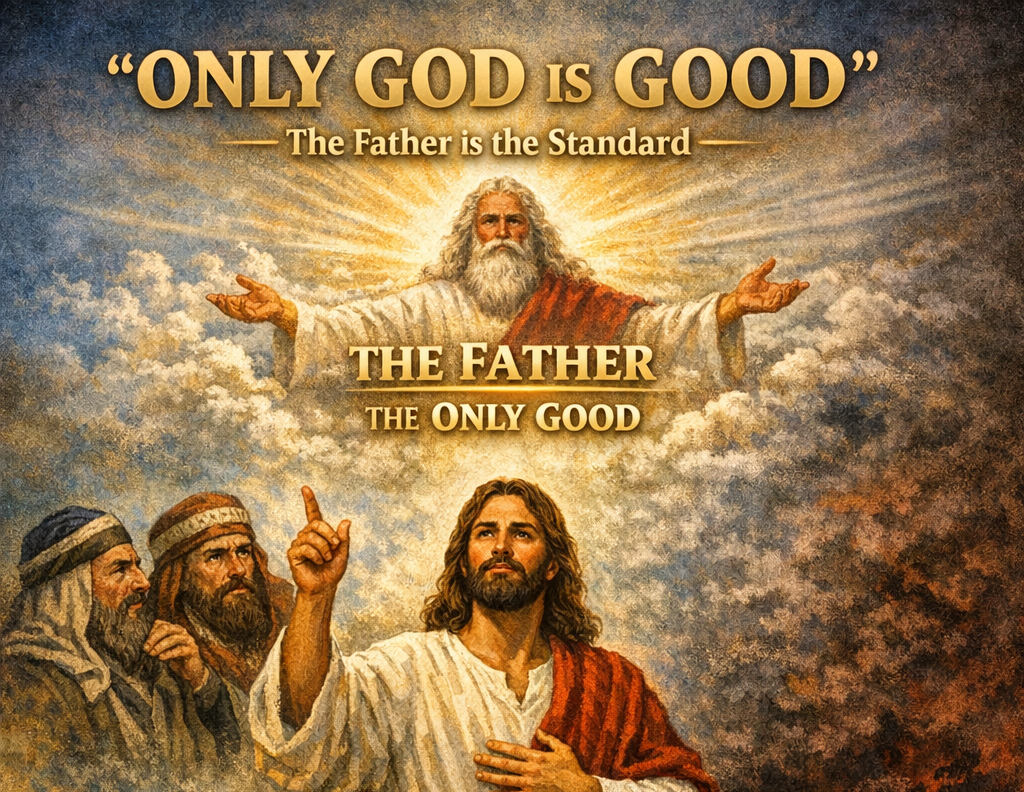
Several times, religious leaders came to Jesus for the express purpose of tripping him up. One time they came to him and addressed him as “good teacher.” He cut them off and asked why they called him “good.” He told them there is only one who is good, and that is God the Father.
One could get into the whole debate of: if Jesus is God and God is good, then isn’t Jesus good as well and subsequently, Jesus was wrong. Uh, yeah. That misses the point Jesus was making. As he has said himself, all he did was intended to glorify and point men to the Father.
Jesus was making the point that the Father is the only good. The argument is not if something is evil or good. The opposite of good is not evil. Technically and philosophically, the opposite of good is not good. Something is either good or not good. The only good is the Father. He is the standard by which all else is judged. Though it could be argued anything that is not godly is evil since all that is godly is good. Either way, there is no neutral. Everything is either good or not good.
The Standard
Since God is the standard of good, then all thoughts, words, and actions must be measured against God. For something to be good, it has to be godly. Scriptures paraphrased come to my mind as I ponder this: “as God is truth, every man is a liar” and “our righteousness is a filthy rags” compared to God and “there is none righteous, no not one.”
So how can anything other than God be good? Simply, nothing which originates with mankind is good. It has to originate with the only “good.” As James has said, “Every perfect gift comes down to us from the father of heavenly lights.” And as several contemporary Christian songs point out, He is good and a “good, good, Father.”
Our Goodness
Our goodness or righteousness has to be His goodness or righteousness in us. The good in us has to be His. Are our thoughts good? Are they pure? Do you have the “mind of Christ” Paul speaks of? Are your thoughts godly? The honest answer would be not all the time. Then the question would be what do you do with the ungodly thoughts? Do you take every thought captive, again as Paul has stated?
What about words? Jesus said every word would be judged. The Bible states our words have the power of life and death. Sticks and stones cannot penetrate nor leave scars as deep as words. Do our words build up and encourage or do they tear down and destroy? Are they good or not good?
Actions. The same standard applies here as well. What are the intentions of our actions? Are they self-seeking or do we use our actions to bring goodness into a not good world? It goes along the lines of “What would Jesus Do?” But this can also be applied to the two previous paragraphs: “What would Jesus think?” and “What would Jesus say?”
In the Beginning
In the beginning, everything God created was good. Why? Because He said it was and the reason He said it was is because it was an extension of Him. Then came the fall of mankind and subsequently all of creation. This left all creation as being less than godly and not good.
But God, (I love those two words) was not content to leave all in this state of non-good. Enter Jesus and John 3:16-18a to counteract John 3:18b-20. God created, creation fell, and Christ re-created. A new creation for all of us who have embraced the Son via John 3:21 and Romans 10:9-10. When we fall, we embrace I John 1:9.
The Standard Applied
The standard can only be applied by those who have recognized their helplessness. They realized they could not save themselves, but Jesus can. They have become new creations in Christ. They have a new beginning.
But one may ask, “Where do I start to determine if my thoughts, words, and actions are good?” The Bible is God’s written word and is the standard for the believer. Our lives must be examined in accordance with His word.
Paul told the early believers to “examine themselves.” Here are some great scriptures to use as a measuring stick:
For Thoughts:
Finally, brothers, whatever is true, whatever is honorable, whatever is just, whatever is pure, whatever is lovely, whatever is commendable, if there is any excellence, if there is anything worthy of praise, think about these things. Philippians 4:8 (ESV)
For Words:
Let your speech always be gracious, seasoned with salt, so that you may know how you ought to answer each person. Colossians 4:5 (ESV)
For Actions:
But the fruit of the Spirit is love, joy, peace, patience, kindness, goodness, faithfulness, gentleness, self-control; against such things, there is no law. Galatians 5:22–23 (ESV)
What Then?
When we examine ourselves, we will find imperfection. That’s where God’s grace comes in. His grace is expressed in I John 1:9. God expects us to move forward to allow the Holy Spirit to work in us to refine our thoughts, words, and actions. We don’t stop with the new creation. We keep going. As I once heard Jim Cymbala, pastor of the Brooklyn Tabernacle say, “The Christian life is a life of 10,000 new beginnings.”
 The Salty Eclectic